Kisan Credit Card Scheme: Eligibility & Application Guide

The Kisan Credit Card (KCC) Scheme is a revolutionary initiative designed to provide timely and adequate credit support to farmers from the banking system. Launched in 1998, the KCC aims to meet the comprehensive credit requirements of the agriculture sector, including crop production, post-harvest expenses, and working capital for allied activities. This guide will walk you through everything you need to know about the KCC scheme, from who can apply to the detailed application process.
Understanding the Kisan Credit Card Scheme
The Kisan Credit Card is not just a card; it’s a flexible credit system that empowers farmers by ensuring access to institutional credit at competitive interest rates. It helps farmers purchase inputs like seeds, fertilizers, and pesticides, invest in farm machinery, and manage daily operational expenses without falling into the debt trap of informal lenders. The scheme also supports farmers by linking to other beneficial programs, such as the Pradhan Mantri Fasal Bima Yojana, providing a safety net against crop losses.
Who is Eligible for a Kisan Credit Card?
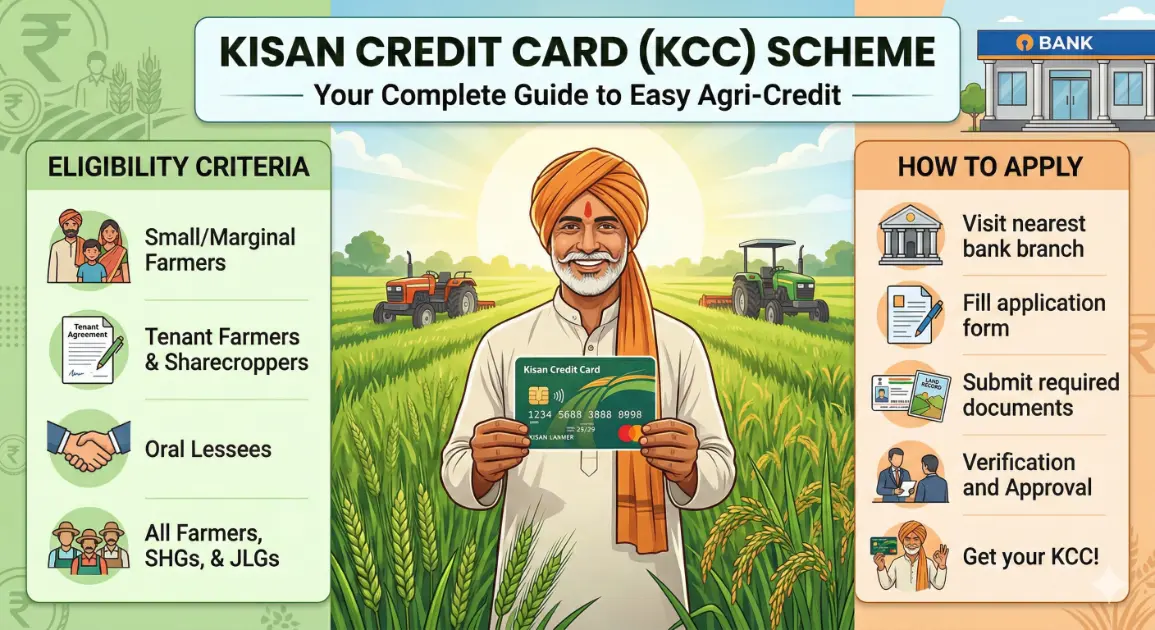
The Kisan Credit Card (KCC) scheme is inclusive, designed to cover a wide range of agricultural practitioners. Understanding the eligibility criteria is the first step towards availing this vital financial support.
Key Eligibility Requirements:
- Farmers – Individual/Joint Borrowers: All farmers, including individual cultivators and joint borrowers, who are owner cultivators.
- Tenant Farmers, Oral Lessees & Sharecroppers: These farmers are also eligible, provided they can furnish satisfactory proof of cultivation.
- Self Help Groups (SHGs) & Joint Liability Groups (JLGs): Groups of farmers, including tenant farmers, sharecroppers, etc., are eligible to apply for KCC.
- Age Limit: The applicant’s age must typically be between 18 and 75 years. For applicants above 60 years, a co-borrower who is an heir or a close relative below 60 years of age is often required by banks.
- Land Holding: Applicants must possess land records for agricultural land. For tenant farmers/sharecroppers, a suitable undertaking or proof of cultivation agreement is needed.
- Farming Activities: The applicant must be engaged in agricultural and allied activities, which include crop production, animal husbandry, pisciculture, horticulture, etc.
It’s crucial that applicants do not have any existing Kisan Credit Card from another bank or have outstanding dues that could hinder their new application.
Essential Documents for KCC Application
Gathering the correct documents is vital for a smooth Kisan Credit Card application process. Banks require these documents for verification and to assess creditworthiness.
- Completed KCC Application Form: This can be obtained from your nearest bank branch or downloaded from the bank’s official website.
- Identity Proof: A valid government-issued photo ID such as:
- Aadhaar Card
- PAN Card
- Voter ID Card
- Driving License
- Address Proof: Documents to confirm your residential address:
- Aadhaar Card
- Utility Bills (Electricity, Water, Gas)
- Passport
- Land Ownership/Cultivation Documents:
- Patta, Khasra, Jamabandi (land records showing ownership)
- For tenant farmers/sharecroppers: Lease agreement, rent agreement, or an affidavit confirming cultivation.
- Passport-sized Photographs: Recent photographs of the applicant.
- Affidavit: A declaration stating that the applicant does not have any other Kisan Credit Card or outstanding dues from other banks under this scheme.
- Other Documents: Some banks may ask for additional documents like a copy of your bank passbook, CIBIL score details (though often checked by the bank), or details of farming activities.
Remember, all photocopies of documents should be self-attested.
The KCC Application Process: Step-by-Step Guide
Applying for a Kisan Credit Card is a straightforward process, typically completed through public sector banks, Regional Rural Banks (RRBs), or co-operative banks. Here’s a step-by-step guide:
Step 1: Obtain the Application Form
Visit your nearest bank branch (e.g., SBI, PNB, Bank of Baroda, etc.) or check their official website to download the KCC application form.
Step 2: Fill Out the Application Form
Carefully fill in all the required details, including personal information, land details, crop information, and financial requirements. Ensure all information is accurate to avoid delays.
Step 3: Attach Required Documents
Attach all the necessary documents as listed above, ensuring they are self-attested. Create a checklist to ensure nothing is missed.
Step 4: Submit to the Bank
Submit the completed application form along with all supporting documents to the relevant bank branch where you wish to avail the KCC. The bank will then verify the details.
Step 5: Verification Process
The bank will conduct due diligence, which includes verifying your land records, identity, address, and often a CIBIL score check. They may also visit your farm for an on-site assessment. For comprehensive farmer support, you might also consider checking your PM Kisan beneficiary status, as this often indicates your registration in government farmer databases.
Step 6: Sanction and Issuance
Upon successful verification and approval, the bank will sanction your Kisan Credit Card limit and issue the card. You will then be able to access credit for your agricultural needs. In some cases, farmers struggling with existing loans might also find relief through schemes like debt relief for farmers, which highlights the broader government commitment to farmer welfare.
Benefits of Kisan Credit Card
The Kisan Credit Card offers numerous benefits to farmers, making it an indispensable tool for agricultural finance:
- Flexible and Hassle-Free Credit: Provides credit for cultivation, post-harvest expenses, marketing of produce, and working capital for allied activities.
- Low-Interest Rates: Farmers can avail KCC loans at attractive interest rates, often subsidized by the government (e.g., 2% interest subvention and 3% prompt repayment incentive, effectively bringing the rate down to 4%).
- Timely Access to Funds: Ensures farmers have liquidity when needed, preventing reliance on informal, high-interest loans.
- Crop Insurance Linkage: KCC holders are mandatorily covered under the Pradhan Mantri Fasal Bima Yojana (PMFBY) for notified crops, offering financial security against crop failure.
- Repayment Flexibility: Repayment schedules are aligned with the harvesting and marketing period of the crops, reducing the burden on farmers.
Frequently Asked Questions
The primary purpose of the Kisan Credit Card (KCC) Scheme is to provide short-term credit for crop cultivation and other farming activities, ensuring farmers have timely access to funds. It also covers post-harvest expenses and working capital for allied activities, helping farmers manage their finances efficiently.
Individual farmers, joint borrowers, tenant farmers, oral lessees, sharecroppers, and even Self Help Groups (SHGs) or Joint Liability Groups (JLGs) of farmers are eligible to apply for a KCC. The scheme aims to cover a broad spectrum of agricultural practitioners.
Key documents required include a completed KCC application form, identity proof (like Aadhaar or PAN card), address proof, land ownership or cultivation documents (e.g., Patta, Khasra), and passport-size photographs. Banks may request additional supporting documents as part of their verification process.
Yes, tenant farmers, oral lessees, and sharecroppers who cultivate land owned by others are also eligible for the KCC scheme. They must provide appropriate agreements or other suitable proof of cultivation to the bank to substantiate their application.