How to Sell Crops on e-NAM: Online Bidding Process Explained

In a major push towards modernizing agricultural trade, the National Agricultural Market (e-NAM) has emerged as a revolutionary platform for Indian farmers. This online trading portal connects agricultural mandis across the country, allowing farmers to sell their produce directly to a wider pool of buyers, ensuring fair prices and transparent transactions. Understanding the online bidding process on e-NAM is crucial for every farmer looking to maximize their earnings and streamline their selling experience.
Understanding the e-NAM Platform
The e-NAM platform is an online pan-India trading portal that provides a common market for agricultural commodities. It aims to integrate existing APMC (Agricultural Produce Market Committee) mandis across states, creating a unified national market for agricultural produce. This digital marketplace brings transparency and efficiency to the trading process, moving away from traditional physical auctions to a more competitive and accessible online bidding system. For a more comprehensive overview, refer to our detailed eNAM guide.
Benefits of Selling Crops on e-NAM for Farmers
Selling your harvest through e-NAM offers several distinct advantages over conventional methods:
- Wider Market Access: Farmers are no longer limited to local buyers. e-NAM connects them to buyers from various mandis across different states, significantly expanding their market reach.
- Transparent Bidding: The online platform ensures a transparent bidding process, where buyers compete openly, often leading to better price discovery for the farmer’s produce.
- Better Price Realization: With more buyers and competitive bidding, farmers have a greater chance of securing optimal prices for their crops, improving their income.
- Online Payment: Payments are processed directly to the farmer’s bank account, often within a stipulated timeframe, ensuring timely and secure transactions.
- Quality-Based Pricing: The system emphasizes quality assaying, ensuring that better quality produce fetches a premium price, rewarding farmers for their efforts.
- Reduced Intermediaries: By connecting farmers directly to buyers, e-NAM helps in minimizing the role of multiple intermediaries, potentially increasing the farmer’s share of the final price.
Step-by-Step Guide to Selling Crops on e-NAM
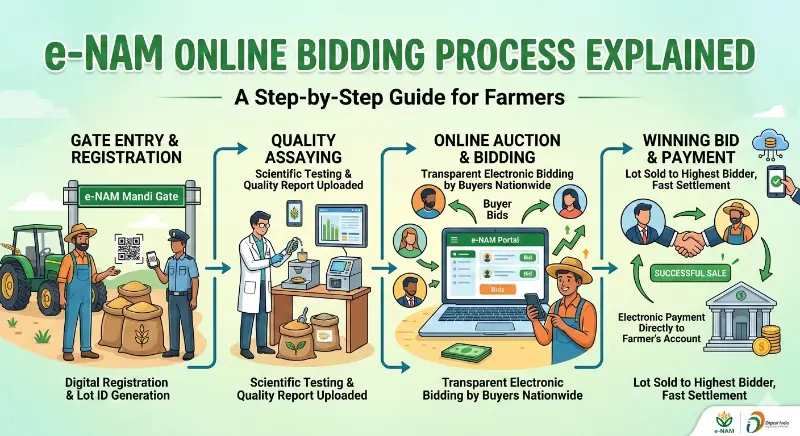
The process of selling your crops on e-NAM involves a few key steps, from registration to final payment.
1. e-NAM Registration and Profile Creation
Before you can sell, you need to be registered on the e-NAM platform. Farmers can register individually or through their Farmer Producer Organizations (FPOs). The registration typically requires:
- Aadhaar Card
- Bank Account details
- Land records or cultivation proof
- Mobile number
For a detailed guide on registration, including the latest eNAM 2.0 updates, please visit our eNAM 2.0 registration guide. Once registered, you will receive a login ID and password.
2. Bringing Produce to the APMC Mandi
After successful registration, bring your harvested crops to the designated e-NAM-enabled APMC mandi. Here, the produce undergoes a critical assessment:
- Lot Creation: Your produce will be weighed and grouped into marketable lots.
- Quality Assaying: Mandi personnel will assess the quality parameters of your produce (e.g., moisture content, cleanliness, grade). This scientific assaying ensures fair valuation.
- Uploading Lot Details: The details of your assayed lot, including quality parameters and quantity, are uploaded onto the e-NAM portal against your farmer ID.
3. Online Bidding Process
Once your produce details are live on the platform, the online bidding process begins:
- Buyer Access: Registered buyers, both local and from distant mandis, can view your produce details, including its quality report and images.
- Competitive Bidding: Buyers place their bids online for your lot. The system facilitates a transparent auction, often for a predetermined period.
- Real-time Updates: You, as the seller, can monitor the bidding process in real-time, observing the prices offered by different buyers.
4. Acceptance of Bid and Transaction Confirmation
After the bidding period concludes:
- Highest Bid: The system identifies the highest bid for your lot.
- Farmer’s Consent: The mandi official will communicate the highest bid to you. You have the choice to accept or reject the bid. If you accept, the transaction is confirmed.
- Sale Confirmation Slip: A sale confirmation slip is generated, detailing the agreed price and buyer information.
5. Payment and Delivery
Following the transaction confirmation:
- Payment Processing: The buyer deposits the payment into the mandi account, which is then swiftly transferred to your registered bank account. This typically happens within 24-48 hours.
- Logistics and Delivery: Once payment is confirmed, you or the mandi facilitates the delivery of the produce to the buyer. In some cases, logistics services integrated with e-NAM can assist with transportation.
Tips for Farmers for Successful Selling on e-NAM
To make the most of the e-NAM platform, consider these best practices:
- Ensure Quality: High-quality produce with proper grading and sorting will always fetch better prices.
- Understand Assaying: Familiarize yourself with the quality parameters used for your specific crops to better prepare your produce.
- Monitor Market Prices: Keep an eye on the prevailing prices for your crops on e-NAM and other markets to make informed decisions about accepting bids.
- Maintain Records: Keep records of your e-NAM transactions, including bids, sales, and payment confirmations.
- Seek Assistance: Don’t hesitate to ask mandi officials or e-NAM facilitators for help if you encounter any difficulties.
e-NAM represents a significant step towards empowering farmers with better market access and fair price discovery. By understanding and utilizing its online bidding process, farmers can take control of their sales and contribute to a more efficient and transparent agricultural ecosystem.
Frequently Asked Questions FAQs
e-NAM, or the National Agricultural Market, is an online trading portal that integrates APMC mandis across India. It provides a common market for agricultural commodities, benefiting farmers by offering wider market access, transparent bidding for better price discovery, and secure online payments directly to their bank accounts. This reduces the role of intermediaries and ensures quality-based pricing.
Selling crops on e-NAM involves several steps: first, register on the platform (individually or via FPO). Then, bring your produce to an e-NAM-enabled mandi for lot creation and quality assaying. The details are uploaded, and an online bidding process ensues. You then accept the highest bid, followed by secure online payment and delivery of the produce to the buyer.
For e-NAM registration, farmers typically need to provide their Aadhaar Card for identity verification, bank account details for direct payment transfers, and land records or cultivation proof to confirm their status as a farmer. A valid mobile number is also essential for receiving updates and notifications related to transactions.
After a farmer accepts a bid on e-NAM, the buyer deposits the payment into the mandi’s designated account. From there, the funds are securely and promptly transferred directly to the farmer’s registered bank account. This direct transfer mechanism ensures transparency, reduces payment delays, and enhances trust in the digital trading platform.